IoT and Smart Lockers – What Connectivity Makes Possible
What Does IoT Mean for Lockers?
IoT stands for "Internet of Things" – physical devices that communicate with each other over the internet. In everyday life, you encounter this with smart thermostats, connected alarm systems, or intelligent speakers.
For lockers, the principle works exactly the same: the lock is connected to the cloud and can receive commands and send data in real time. It "knows" whether it's occupied, who last opened it, and what the battery level looks like.
IoT Simply Explained
Imagine a locker that's not just a metal cabinet with a lock – but a device that's permanently online. It can be opened via cloud command, reports its status, and can be integrated into other systems (e.g., booking platforms, ERP, or employee management).
Online-Capable Hardware as the Foundation
For a locker to become "smart," it needs an electronic lock with internet connectivity. This can happen via WiFi, LTE, or a local gateway. The crucial point: the lock communicates in real time with a central cloud platform.
This fundamentally distinguishes IoT lockers from classic systems with offline locks. An RFID lock that only works locally cannot send data or receive commands. An IoT lock, on the other hand, is part of a network – like the TIKI Smart Locker.
What Can Be Controlled
Once the hardware is online, possibilities open up that simply wouldn't be feasible with a classic lock:
Remote Opening
Every lock can be opened remotely at any time – via dashboard or API.
Real-Time Permissions
Who can open which compartment? Permissions are assigned or revoked instantly.
Status Monitoring
Battery level, occupancy, door status – all in one central overview.
All of this is managed via a central locker management software – a platform that brings together all locks, users, and rules.
Areas of Application
Connected lockers make a difference wherever physical items need to be handed over securely and traceably:
Parcel Handover
Packages are deposited in the compartment, the recipient gets a code – contactless and time-independent.
Tool Distribution
Employees scan their badge, pick up the tool – everything is automatically logged.
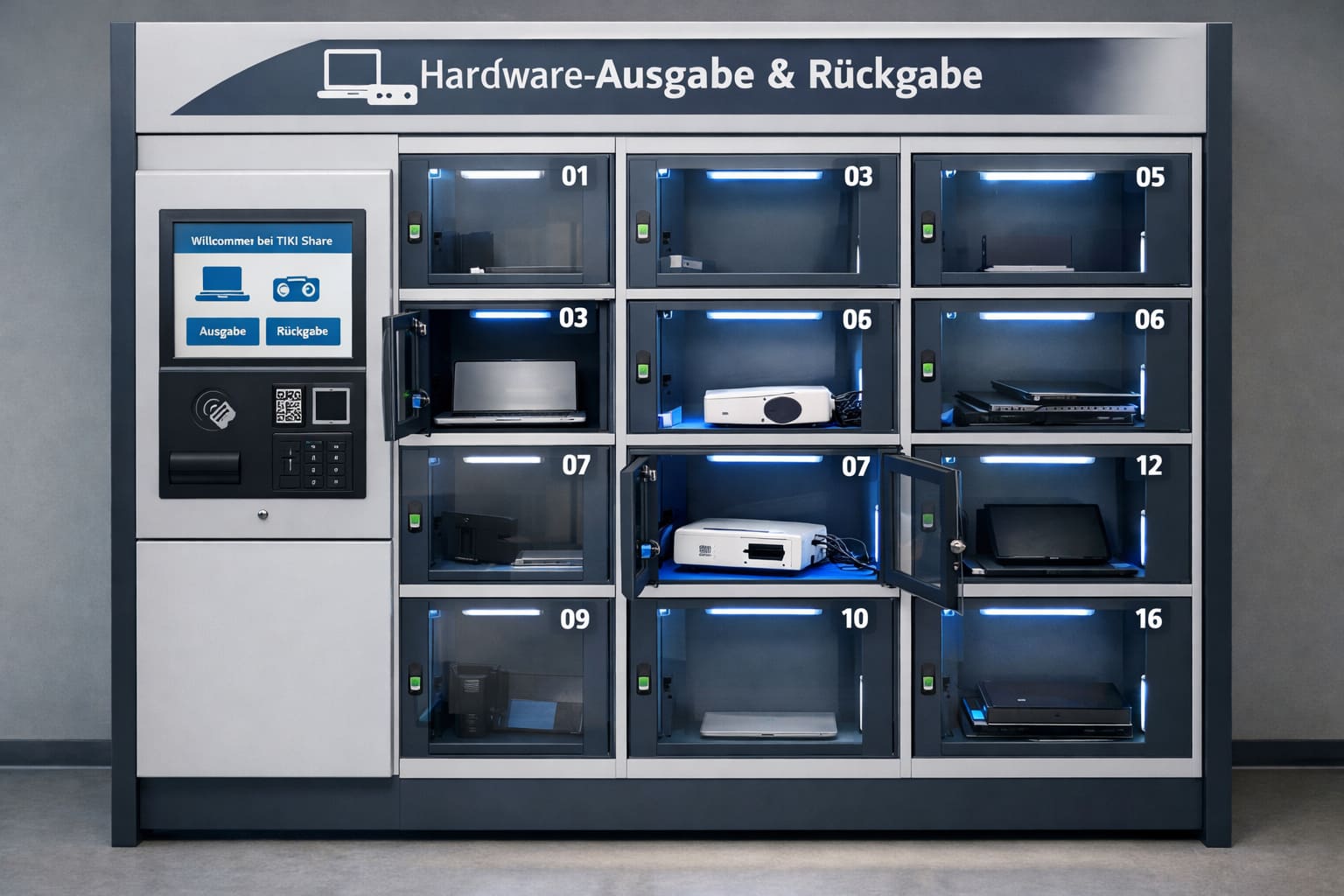
IT Equipment
Laptops, headsets, or chargers are distributed via smart compartments – with per-employee access rights.
Conclusion
IoT transforms a simple metal cabinet into an intelligent handover system. Connectivity enables functions that wouldn't be conceivable with classic locks: real-time control, automatic logging, and integration into existing systems.
Whether parcel handover, tool distribution, or IT equipment – the basic logic is always the same: one compartment, one lock, one cloud. And that's exactly the foundation of the TIKI SHARE platform.