Electronic Door Lock – What Really Matters When Choosing
Types of Electronic Door Locks
Electronic door locks come in various designs – each with its own strengths. You can find a detailed definition of electronic door locks in our glossary. The three most common types:
- Electronic Cylinders: Replace the mechanical cylinder in the existing door fitting. No door modification needed – ideal for retrofitting.
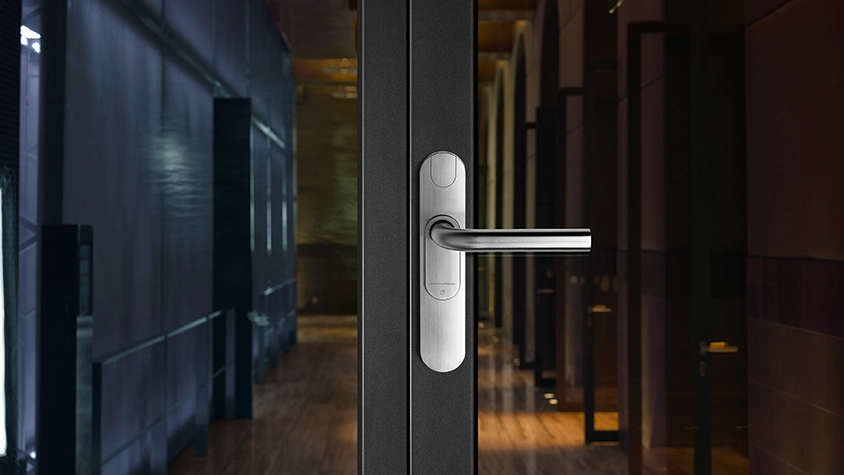
- Smart Door Handles: Handles with integrated reader. Visually appealing and easy to use.
- Wall Readers: Separate reading devices next to the door that control an electric door opener or motor lock. Standard in office buildings.
Online vs. Offline – The Crucial Difference
The most important question when choosing is not "Which lock?" but "Online or offline?". The difference is fundamental:
An offline system stores all permissions locally on the lock or access medium. Changes require physical access. An online system, on the other hand, is connected to the cloud – permissions can be assigned, changed, or revoked in real time.
| Criterion | Offline | Online |
|---|---|---|
| Central Management | No – rights must be programmed on-site | Yes – all locks controllable via one dashboard |
| Real-Time Changes | Impossible – changes require physical access | Instant – rights assigned or revoked in seconds |
| Logging | Stored locally – must be read out manually | Automatically in the cloud – viewable anytime |
| Remote Opening | Not possible | One click from the dashboard |
| Scalability | Complex – each lock configured individually | Simple – new locks instantly integrated |
| Costs | Lower acquisition, higher admin effort | Higher acquisition, significantly lower operating costs |
Access Methods: RFID, Smartphone, QR Code
Regardless of the design, the question arises: how is the lock opened? RFID technology remains the standard – but smartphone and QR code are gaining importance.
RFID Card / Transponder
The classic: a card or transponder is held to the lock. Fast, reliable, and ideal for companies with many users.
Smartphone App
The lock is opened via app – using NFC or QR code. Ideal when no physical media should be issued.
QR Code / PIN
A temporary QR code or PIN is sent via email. Perfect for visitors, guests, or time-limited access.
What to Look For
A common mistake: focusing only on the lock – and forgetting the system behind it. Because hardware is interchangeable, software is not. Pay attention to:
Decision Guide
- Is the system online-capable? Only this way can you manage permissions centrally and change them in real time.
- Can the software connect to existing systems? ERP, booking platform, employee management – integration determines the benefit.
- Is the hardware interchangeable? A good platform supports locks from various manufacturers – you're not locked into one vendor.
- Is there an API? For connecting to your own systems or third-party software, an open interface is essential.
Our access control solutions start exactly here: an open platform that unifies different locks, access methods, and systems in one interface.
Conclusion
An electronic door lock is only as good as the system it's embedded in. Anyone planning long-term should go for an online system that offers central management, real-time control, and flexible access methods. The hardware itself is then just one building block – not the limiting factor.